Technology Evaluation: What's New in Nuclear Power?
- jespenscheid
- Feb 5, 2021
- 4 min read
Updated: Mar 13, 2021

The nuclear powerplants which currently exist in the world can be categorized into three or four generations, depending on who you ask. We will go with three, because that is what makes the most sense to me. Generation one reactors refer to the earliest prototype nuclear power plants, developed in the mid-fifties to early sixties in the US and UK. These relatively small scale powerplants primarily functioned as a proof-of-concept for nuclear power, and all of them have been decommissioned by now. Generation two nuclear powerplants were built throughout the developed world from the late nineteen-sixties up until the mid nineties. These reactors were designed for commercial use in generating electricity and were meant to run for about forty years before major overhauls or decommission was expected to become necessary. There are several different reactor technologies which encompass generation two, the most common of which are the light water reactors. Generation two also consisted of CANada Deuterium Uranium reactors, advanced gas-cooled reactors, and Vodo-Vodyanoi Energitichesky Reactors. Most of these powerplants incorporated mechanical and electronic active safety measures. Modified designs of gen two reactors were built in Asia up until the early 2000s. These powerplants are designed to work within a robust grid system and produce large volumes of high-level nuclear waste. Most of the nuclear powerplants constructed since the mid-nineties have had generation three reactors. These plants are more thermally efficient and safer. Many gen three nuclear plants adhere to a standardized, modular design; with passive safety measures which should function to prevent a nuclear disaster without human intervention or even electricity. Generation three nuclear reactors are intended to last upwards of 60 years before major overhauls and replacements are necessary, and have reduced fuel consumption and waste production compared to gen two.
Contemporary advancements in nuclear power are centered around small modular reactors. These reactors produce less power than previous designs, but cost less to build and may be more practical in countries with lower electricity demands or less robust infrastructure. Emergent technologies designed to be used in small modular reactors include: water-cooled reactors with small coated particle fuel (without on-site refueling), sodium-cooled small reactor with extended fuel cycles, lead or lead and bismuth cooled small reactors with extended fuel cycles, gas-cooled thermal neutron spectrum reactor, gas-cooled fast neutron spectrum reactor with extended fuel cycle, and salt-cooled small reactor with pebble-bed fuel. American energy company Westinghouse hopes to be able to produce microreactors based on a design by Los Alamos National Laboratory that would be small enough to fit on a semi-truck within just 5 years time. Microreactors will be constructed entirely in a factory and are not meant to be installed anywhere permanently. These reactors will be able to be transported to where power is needed and immediately begin generating 1-20 MW of thermal energy. Additionally, microreactors should be able to be operated by a very small number of technicians compared to traditional reactor designs, due to their small size and the self-adjusting technologies that are incorporated in them. The Los Alamos design is intended to be able to be used for ten years before needing to be refueled. Bringing nuclear energy to a portable scale will open up numerous exciting applications for microreactors, such as disaster relief.

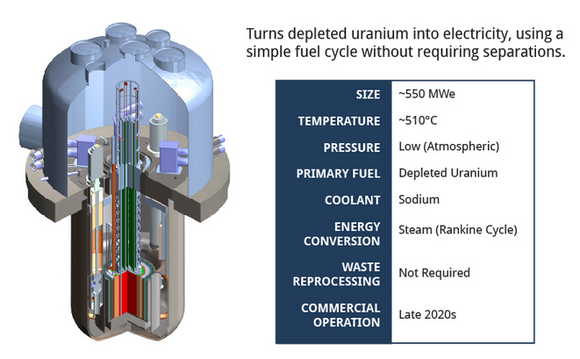
Nuclear scientists hope to develop generation four nuclear technology within the next couple decades. There are many generation four reactor design currently being worked on, all with the eventual goal of creating truly sustainable nuclear power. Generation four nuclear reactors should produce more fuel than they consume; using uranium 238 as an input fuel, instead of enriched uranium (isotope 235). Generation four reactors promise to eliminate long-lived (radioactive) elements from the nuclear waste stream, which will require reprocessing technology that can completely separate heavy elements from spent fuel. Generation four nuclear facilities will also include a final repository to permanently store fission products which cannot be reused. High energy neutrons can be used to both efficiently breed new nuclear fuel and destroy heavy elements via fission. Generation four reactors will need to be designed in a way that preserves the energy of neutrons used in fission. A generation four nuclear system will need to reprocess spent fuel in order to chemically separate heavy elements from nuclear waste. There are two methods that can be used to reprocess fuel: aqueous and pyrochemical, but neither of these have been perfected to the degree that they would need to be in a generation four setup. Within the next couple of decades it may be possible to build a sustainable and safe nuclear power system from generation four technologies, that can create huge amounts of power from a closed fuel cycle.
Research is also currently being done on examining the potential of using nuclear fusion to create electricity. Fusion reactions are initiated by confining atoms (like hydrogen) into a small enough space that their nuclei must fuse together. This is done by immense heat and pressure, like that which exists inside a star. Modern nuclear weapons use x-rays created by nuclear fission to initiate a fusion reaction, with explosive results. When a deuterium and tritium atom fuse together, they create a helium atom; some of the fuel's mass is lost during fusion, so along with the helium atom, a huge burst of energy is released. There are two basic techniques researchers use to confine fuel plasma into conditions where fusion will occur. One of these is magnetic confinement fusion, which is used in tokamaks. Tokamaks use magnetic coils to confine hydrogen into a low density plasma inside of a vacuum chamber, eventually initiating fusion. The other technique is inertial confinement fusion. ICF starts a fusion reaction by imploding a small amount of fuel into a high density plasma in an instant. The implosions necessary for ICF can be initiated by powerful lasers, such as those located at the Lawrence Livermore National Laboratory's National Ignition Facility; or, if the liner of the fuel capsule is magnetized, by a powerful z-pinch. Unfortunately, reliably creating nuclear fusion and extracting energy from it in an economical manner seems to be a long way away; although the largest tokamak in the world is currently under construction in a collaborative effort by 35 nations at the ITER facility in southern France.


Comments