The Problem With Autonomation
- jespenscheid
- Feb 5, 2021
- 3 min read
Updated: May 3, 2021
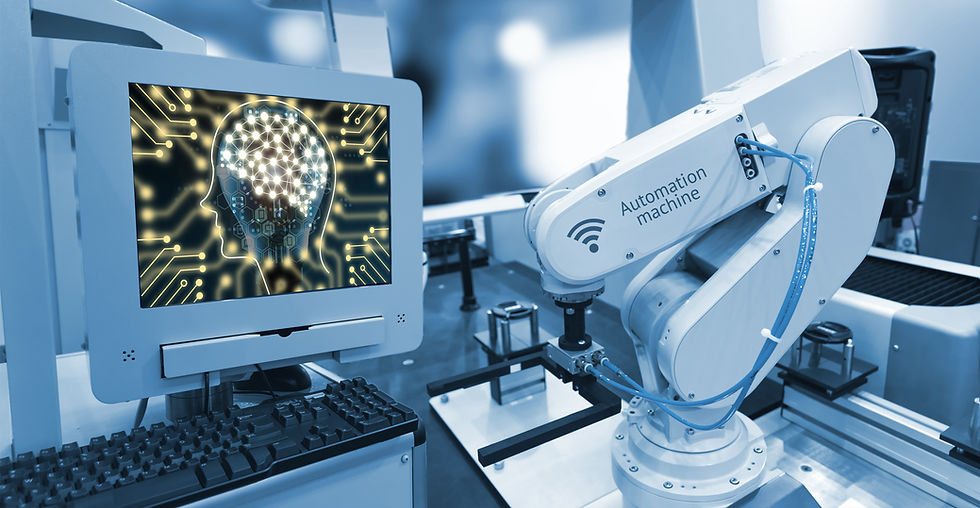
As technological developments in the fields of robotics and AI continue to advance at a staggering pace, we find ourselves in a rapidly changing world. While in the past, most technological advancements have resulted in an increased quality of life for the societies which develop and implement them; there has long been an anxiety that developments in robotics and AI are an exception to the trend. I think this is a logical fear.
Unlike throughout most of our history, many of the struggles that society faces do not seem to be solvable with increased production or resource acquisition. To give a rather simple example: at present, we produce enough food to feed the world, yet hunger and malnutrition persist even in the wealthiest nation in the world. Of course, there are many dimensions to the food problem; but I think it serves as a good analogue for many issues in the world today.
The way that our society seems to want to address these complex issues, however, almost always falls back to an increase in production. How do we feed the hungry? Grow more food, most people will say; but as I mentioned earlier, we already have enough food. I'm not sure if this mindset is rooted in our capitalist economic structure, or perhaps somewhere deeper within the human psyche; but either way, it isn't always the best way to try to solve problems.
What does this have to do with robots? In seeking to increase production and acquire more resources, we have become increasingly reliant on automation. Robots are better at some things than us, but the real advantage of them is that they are more efficient, more economical. Robots do not need to sleep or eat, or earn a living wage; and with advancements in AI, robots are excelling at increasingly skillful professions. The word robot actually comes from the Czech robotnik, meaning forced laborer; to work is what robots are designed to do.
Earlier I mentioned capitalism as a potential source of our production-oriented mindset. I bring it up once more, because it seems to struggle with providing for human beings in a world where; with the help of robotics, AI, and other technologies; global production does continue to grow exponentially. Prior to a few centuries ago, society had a great many ills, but unemployment was rarely one of them. There was always work to be done, and the only people who didn't work were those who couldn't. Today, due to increased automation, unemployment and underemployment are perpetual issues.
Today, the average person in the developed world consumes an amount of resources and energy which was never previously possible, to the detriment of our environment. Still, many of us, particularly people who live in rural areas; cannot find the work they need to support themselves. Even among those of us who have jobs; most lack the fairly compensated, stable, careers necessary to raise a family and save for retirement.
Economic inequality and declining prosperity are manifold problems, and I do not mean to blame them solely on automation; but it is easy to observe that AI and robotics are doing an increasing amount of work, to the detriment of those whose jobs are eliminated on the way. Cars, which not twenty years ago were built by paid human employees with the assistance of some heavy machinery in automotive plants across the world; are now almost entirely assembled by automated robotic arms, owned outright by the car manufacturer.
Much of the economic growth in this country, in recent years, has been in the service sector and so-called gig economy. Many of these new jobs may soon be replaced by AI and robotics as well; particularly with the exciting research being done in technologies like driverless vehicles, which could soon replace your Uber or delivery driver, as well as truckers who haul goods across the country. I am not suggesting that we smash and burn exciting new technology, with the potential to solve problems, as the Luddites once did; but developments in AI and robotics create issues which we ignore at our peril.
Personally, I think the solutions to these problems will be primarily political; like a stronger social safety net funded by taxes on large corporations and the uber-wealthy, or universal basic income. These ideas are not immune from many valid criticisms, but no matter how you look at it, AI and robots are only getting more sophisticated and commonplace.


Comments